Tuesday, August 27, 2013

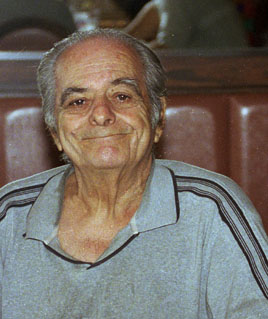
ED Galing 96-- Profiled in the Philadelphia Inquirer

ED Galing with his lifetime Achievement Award ( photo from Philadelphia Inquirer--Luke Rafferty)
Posted: August 25, 2013


Ed Galing cannot get enough.
Enough attention. Enough praise. Enough love. Enough life.
And if he hasn't had his fill at 96, he is unlikely to ever feel completely sated.
"I love publicity," Galing said, with characteristic candor. "I'm famous!"
In June, the mayor of Hatboro gave Galing a lifetime achievement award for his more than 16 years as poet laureate of the Montgomery County town.
"It's like being in the Kennedy Center, and the president puts a medal around their neck," Galing said in his gravelly voice. "Lifetime achievement!" he marveled. "Not everybody gets that. You have to earn it."
These days, Galing does not get many visitors. His sons, both in their 70s, live too far away to make the trip very often to the family's brick Colonial, where Galing still lives. And the grandchildren and great-grandchildren? "They're just too busy," Galing said.
Since his wife, Esther, died six years ago, he spends most days in his own still-plucky company. Alone, that is, except for an aide, who comes for a few hours a day, and his most loyal companion: a seafoam-green IBM Selectric typewriter.
Every morning at 5, he wakes up, gets out of the hospital bed in his first-floor office, transfers himself into his motorized wheelchair, and hums over to the desk to write for an hour or two.
"I write whatever comes into my head," he said. "Then I put it away and look at it the next day to see if I still like it. If I don't, I throw it away."
That rarely happens.
"I'm a good man, and I know how to write," he said. "Can I read you a poem?"
Without waiting for an answer, he pushes his thick thumb against the joystick of his wheelchair, so well-used that the black vinyl is as cracked and wrinkled as old skin. The chair catches on the threshold to the living room, and he coaxes it onward - "Go! Go!" - then bursts through into the living room.
The tchotchkes, vases, and family photographs remain exactly the way Esther left them, except for a new couch and armchair - gifts from one of their sons.
"He told me he's going to take care of me the best he can," said Galing. "He told me he loved me."
Galing reaches into a bookcase and pulls out one of the many collections of his work.
The World War II veteran graduated from South Philadelphia High School and worked in a variety of jobs, first at the Willow Grove Naval Air Station and, in his later years, processing sales documents for a car dealer. His last job, when he was 80, was custodial work at a restaurant.
That was the year he began writing in earnest, for personal expression, yes, but always, too, in the hope that his work would be recognized.
"Now, I'm in more than 400 publications," he said. "It's like George Bush's Mission Accomplished! Except this is real."
Real enough, in any case, to fill the deeply human need to feel significant. Especially at this far end of the trail. Hard of hearing and crippled by arthritis, Galing writes to be heard. To resist fading into his own shadow.
"If I was 60 right now," he reminisced in a recent letter, "I would be driving a car, going on vacation, making love with my wife, enjoying family picnics . . . and all of us would be young, and laughing, and so very happy."
Describing his life now, he continued: "My fingers are curled, and I live in my wheelchair all the time. However, I can still write."
Galing's poems have appeared in a few small literary magazines, like Red Wheelbarrow and Rattle, and he is a regular contributor to a newspaper for the homeless in Nashville. Much of his work is self-published, such as Pushcarts and Peddlers, a collection of pieces about his childhood in the early 1900s among other poor Jewish immigrants on the Lower East Side of New York.
"It didn't sell as much as I had hoped," he said. "People don't read much anymore."
For a moment, his brave front faltered.
"I'm not really famous," he said. Then he rallied. "But I'm very well-known and very well-liked in the field."
He came too late to computers to master the new technology, he said, but Doug Holder, a fellow poet in Massachusetts, helps him blog by proxy, and praises him as "a poet of the Greatest Generation."
Galing found the poem he was looking for in the bookcase. It describes his childhood in New York, the rooming house where he lived with his mother, and his habit of sitting outside during the hot summers, writing poems on sheets of paper that he would fold into paper airplanes, launch, and watch flutter to the sidewalk.
where the garbage collectors
would sweep it
away
with the rest
of the garbage.
Galing, proud, smiled with satisfaction, plumping up his doughy cheeks.
"Sometimes, I wonder what am I doing, living here in this house with only health aides. It's lonely," he said. "But I don't want to die. I'm going to keep writing till the end of my life."

Monday, May 2, 2011

Ed Galing and Susie Davidson

Susie Davidson, (and her partner Frankie) a reporter for the Jewish Daily Forward, an Ibbetson author, as well as the editor of the critically acclaimed Holocaust anthology "I Refused to Die..." ( Ibbetson Street Press) poses below with small press legend poet Ed Galing. Galing is 94 and just released his new poetry book "Pushcarts and Peddlars" (Poetica Publishing). Davidson recently interviewed Galing for an article in the Forward and visited at his home in Hatboro, PA. in April 2011.


Wednesday, February 9, 2011

Pushcarts and Peddlers by Ed Galing


Puschcarts and Peddlers
Selected Poems by Ed Galing

$18.00 + $3.00 shipping
(all copies are signed by the author)
(ppb. 120 pages)


or mail a check/money order:
Poetica Magazine
Book Order
PO Box 11014
Norfolk, VA 23517


Cover Art Created and Donated
by Eugene Ivanov


Ed Galing is an award-winning ninety-three year old poet, cartoonist, and journalist. He received many literary awards, two pushcart nominations, wrote over seventy chapbooks, and was the harmonica-playing poet-laureate of Hatboro, Pennsylvania. Galing grew up in a tenement building in the Lower East Side of New York, learning about pushcarts, peddlers and bustling immigrants. When he was nine-years old his parents moved to Philadelphia where he finished his high school education, then he began to write short stories, poems, and sketches about his life. Shortly after WWII, Galing joined the Army and served as an occupation soldier in Europe, where he witnessed the death camps in Dachau. Galing married at age twenty-one and lived with his wife Esther for sixty-eight years, until her death. Galing is described by Doug Holder as a "poet of the greatest generation." Mr. Galing does not own a computer, he still communicates with editors and fellow poets by hand written letters. Mr. Galing lives at his home in Hatboro, PA, confined to a wheelchair, and as always, types all his poems using an old typewriter. His greatest wish is to see his Jewish works published and recognized, that those days of experiencing the Lower East Side, Dachau, anti-Semitism in the Army and Navy will never be forgotten. Poetica Magazine and Poetica Publishing Company will grant Mr. Galing his wish and will publish a full collection of his Jewish poems.

We are thankful to the talented and generous artist, Eugene Ivanov, for creating the art for the book cover, free of charge. Ivanov’s art was published on the front cover of our summer 2010 print edition. Visit his amazing work at www.yessy.com/eugeneivanov.

Saturday, January 1, 2011

Lost Piano Concerto


when i lived on the lower
east side of
new york
at the age of ten
the hallways
were all musty,
smelled
from urine,
graffiti on
all the walls,
echos would
float in the air
for miles
one day
in this terrible place
I found a piano,
it was downstairs
ready to be thrown away
an old steinway
with broken keys
rusted out foot pedals
and a roller,
somehow someone in the building
must have
used this piano, wanted
to learn to play it.
must have tried a long
time before giving
it up
i played this piano
everyday, my fingers
stroked the keys
i could only play with
one finger, and though
the notes were sour and
off key, i could play
alexander's ragtime band
it felt so good to
hear those notes
echoing through the hallway
it sounded like real music to me
and everyday i
would look for the piano
and hit the keys
in delight, and it made
me feel so good
the dreary, awful sounds
of the lower east side
melted away.


and i felt sorry for
whoever had thrown
the piano away,
it could be fixed
it thought,
someone could restore
it enough to make
it a grand piano,
and it was gone
someone had taken it
away,
to be tossed out
with the trash like
all the rest
and i felt so bad
about it, i cried...
it almost felt like
it was my own,
and i especially hated that there
would be no music in this awful hallway
only the usual sounds
of misery.

Friday, March 5, 2010

Wheel Chair by Ed Galing


Ed Galing is 92 now, and is basically confined to a wheelchair at home. He has home attendants who help him out. Although his mobility has been affected, his mind is still sharp, and he continues to write poems and essays. Here is his latest:

WHEELCHAIR

i observe the world
theses days
from a sitting position,
no matter those early days
when i ran around the
track at college
in ten minutes flat,
and threw a javelin--
infirmities come
at all times and ages
for me it is
my nineties,
my temporary pain
in my knees
the wheelchair suits me
fine for the present,
i cook in a sitting position
and find no problem in
traversing my room,
trying to reach items
that were so easy to
get to, in standing position,
now it's getting used
to judging height and
distance, no reaching too far,
simply making it another day
my therapist assures me that
in a few months i will be back
on my feet again
and for that i am grateful...
something to be said
for the wheelchair

Wednesday, September 30, 2009

Review of Ed Galing's "Burlesque" by Irene Koronas


burlesque
ed galing
iniquity press/vendetta books
isbn: 1-877968-33-1
2005 4.00

Ed Galing presents a time almost all of us have never heard of, or seen or been privy to, yet, his poems expose us to the bump and grind; strippers and comedians trying to entertain an audience of visually sex starved men. All this comes across in the poems. The reader will enjoy the show and will get acquainted with some of the characters behind the scenes. the poems look at life as it once was, naïve, compared to today.

“puttin the powder
on his scraggly
face

he looked at me
sadly and said

kid, whatever
you do,

don’t go into
burlesque”

Although the verse is brief in presentation, we the reader will come to understand what it means to reveal something never seen in public and we will dance with excitement.

“its only the chorus
girls, mostly,

who will go as far
as your money does.”

Irene Koronas
Submissions Editor
Ibbetson Street Press

Saturday, June 13, 2009

Six on a Stoop By Ed Galing


--------------------------------------------------------------------------------


SIX ON A STOOP


we were all young kids
back then, on the lower east
side of new york, and in the
summer time we sat outside
on the stoop, watching the
people pushing and shoving,
and the pushcarts, and the
garbage, and the noise…
and we would make fun of it
all, like little brats often
do…there were six of us, all
of us full of beans,
for instance, little red-haired
betty, with white stockings,
sticking her tongue out as people
walked by us, and saying stupid
things, like nyah, nyah, nyah…
there was irving, about ten years
old, small, black hair, who
made up songs as people walked by,
and we all laughed as he pointed
out people, and then there was
harry, who lived in the same building,
about eleven, and played a trumpet
so loud we banged on his door…
he would sit on the stoop with us
and make noises with his mouth, like
a trumpet…a real goof ball…
in the summer time, when it was so
hot, we made the stoop our meeting hall…
we chewed gum, hit each other playfully,
and threw things around, and that’s
how the summer went for us…nobody
gave a darn about tomorrow…we were
just kids…in poverty…
years later, as it does,
one of us became a dancer on broadway,
another became a famous song writer,
and still another an orchestra leader,
the other three never amounted
to much, though they tried, because
you can’t really get anywhere, sitting
on a stoop on the lower east side,
no matter how much you try

ED GALING
Pennsylvania

* From Mobius magazine.

Thursday, April 30, 2009

Poems about Ray Charles and Benny Goodman from Ed Galing

RAY CHARLES

his long fingers
on the keyboards
were pure magic
you could see his
fingers move
and listen to the
sound of blues,
his voice, shaking
from side to side,
his smile a part of
the music, there was
no one as good as
ray charles,
a black man who was blind
but not his music
he knew the soul of music
and it was poetry
he could play a song on
your heartstrings and make
you cry
music was his main love
but it wasn't only blues
for he could play the song
"america' like you never heard it before
then
"he girl with the diamond ring, oh,oh,uh, uh"
we repeated his words,
so humble in his presence
i would listen and join in
with my tiny little harmonica,
trying to blend myself into his song
but of course ray
never knew this,
i could never play the blues
as he did, but oh, how i wished
i could...


Benny

those days when we
were between wars
when music made us all
feel good
as we young teenagers
jumped to the music of
benny goodman, and his
licorice stick,
benny, with the large
smile, and wearing glasses,
looked like our grandfather
but oh how he could play
that stick
we would rope off the street
back in 1934
and would turn the radio on
and dance
we turned and whirled
we dipped
we danced close
we made do
with what we had
we were young
and we loved young
and benny's fast
hot jazz
filled our dreams,
for benny knew how to make us
hop and laugh
those trilling
tripping notes
from the clarinet
strings of pearls
dance, dance, dance
oh how we danced:
"bei meir bistdu schoen"
a jewish melody
about how lovely your girl was
and benny turned into a
modern jump
times were good
even when they were bad
the war was a way off
but for now
this was good.

Tuesday, February 10, 2009

Letter about Ed Galing from Philadelphia Poet Janice Jakubowitcz

What should a productive writer do on a snowy homebound afternoon? Write stories, edit stories, send away stories? Recently on a quiet snowy day, I decided to purge some of my files. It’s like the avoidance of studying for a test as a student; I’ll get the writing jitters so cleaning helps to relax. I keep articles from newspapers or magazines that are useful to character development and writing hints. I came across a golden one. It was a Letter to the Editor of my city newspaper written by a 79 year old poet. In this short piece he eloquently explained why he wrote. It touched me again. I didn’t have a date noted and decided to Google his name. I found an interview with Doug Holder and contacted him. It turns out that Ed is now 91 and I had that clipping for 11 years! Doug gave me Ed’s phone number and I called him yesterday. We had a wonderful conversation. He offered to send me books of his poetry but when he found out that I lived around the corner from one of his favorite restaurants, (Jack's Deli) we agreed to meet for lunch when the weather gets better. Also in this incredible connection, I learned through Doug about an ezine that is published locally. They host a poetry reading once a month a block from the train station that I take every day to my job in the city. And it gets better – another poet that I met on line has known Doug and Ed for years! Ah….I love the writing life and the wonderful surprise connections that can occur in this small planet that we live on.


* I agree. The Small Press has provided me with wonderful, interesting, people to talk to you and become friends with. I am not getting rich and I ain't a poet/laureate, and there is a lot grief connected with it, but: "don't change a hair for me, not if you care for me, stay little small press stay,... ( Thank's Cole Porter)--

Doug Holder