Friday, May 1, 2020

Tuesday, November 7, 2017

Wednesday, September 3, 2014
Chicken Soup by Ed Galing

Ed Galing sent me this poem shortly before he died in Dec. 2013:
most of all
i remember
my mother's
chicken soup.
1922
lower east side
i was often sick
my mother
fed me with
a large spoon.
"Eat, eat, you will feel better!"
that aroma
some secret ingredient
did its job.
my mother
overjoyed
nodding
my father smacking
his lips.
she said it was
a jewish dish
but the bible
did not say
this.
" Moses on the Mount,
had a bowl
before he got the
ten commandments."
the entire building
smelled of chicken soup
and matzoh balls
At 96
i'm still not
through
i sip the soup
and eat the matzoh balls
too.
Friday, May 23, 2014
Front Cover Ibbetson Street 35 ED Galing Tribute!

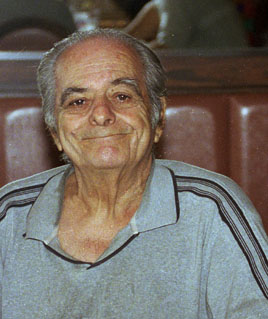
I got this from Ibbetson Street designer Steve Glines. This is the front cover--with some of our featured poets, and the late Ed Galing's resplendent smile as portrayed by artist Ashe Troberg. We will be sending the final PDF to the printer on Friday afternoon, and we hope to have copies in our hand in mid to late June--meanwhile Steve will be putting a print-on-demand issue up that can be ordered. This should be done by next week. You would be doing the press a great favor if you purchased extra copies online from our bookstore... Ibbetson Online Bookstore and don't forget our books--enjoy them and help this small press at the same time!
---Doug Holder
Saturday, May 10, 2014
Poet Ed Galing Presentation: Lizzie Goddard-- Endicott College-- Creative Writing Workshop
 |
| Lizzie Goddard (Author of Ed Galing Presentation) |
Lizzie
Goddard
Ed Galing
Presentation
5/6/14
Ed Galing was born in 1917, died in 2007, and spent his early years in
the lower east side of New York City. He first started to write poetry when he
was a young man during the depression era. His family went through many troubles
while he was growing up and he wrote a great deal about it in his early poetry. His
family was on general relief, they lived in harsh conditions and his home even
caught fire once when he was a boy. He first became involved with poetry when
his high school English teacher, Dr. Ginsberg, got him interested when they read
some poetry in class. The young poet was intrigued. Galing said, “Poetry could
say something in a few words that prose could only do in the thousands. Poetry
allowed me to pour out my heart and soul”. He wrote many poems concerning his
experience with anti-semitism and how enraged it made him. Even though he was a
modern poet, he did not use technology to write his poems. Instead, he hand
wrote them all and did not worry about the new trends that afflicted
contemporary poetry. He wrote about whatever was on his mind and did not concern
himself with the new high tech world. Galing reflected in an interview, “I have
two grandsons, three grandchildren, and I am married to a wonderful woman. What
is there to know about Ed Galing? Just a simple man, trying to write poetry, and
perhaps trying to hear a good word about my work”. The two poems by Galing I am
going to write about are titled “Prayers” and “Obituary”. These two poems both
discuss his impending death. His poetry is very realistic
and he does not puff up his life to transform it into something magical. Ed Galing wrote about
things that concerned, affected, interested and conflicedt him. He wrote what he wanted to write.
The first poem, “Prayers” is a very deep and emotional poem to read.
Galing discusses how he feels after he has lost his wife, his religion, and how
going to these services at temple affected him even more. He discusses how his
prayers and religion are an outlet for him. The passage that touched
me was one that deals with the specter of death, “when it comes to the/ mention of the dead, my / tears wet the pages
before/me until i can't see anymore,/i sob my wife's name/ over and over again”.
After reading these lines, I really felt the emotion that Ed felt as he mourned
his wife’s death. As I read his biography, I did not think he would write such a
deep and emotional poem. This poem caught me by surprise because of it's
imagery. I pictured him alone, praying and crying to his prayer book. I imagined
tears falling from his face and dripping on his prayer book that he held on his
lap. After reading these lines I felt tremendous sympathy for Galing. He seemed
like a positive and realistic person, and so I was surprised put out his
vulnerability in his poetry. The lines that also stuck out to me were,
“i
have lost my wife/ she died this year/ i have nothing much/ to live for,/ when a
man loses his/ wife he loses it/ all”. These lines made me feel sorry for
Galing. He reveals in the poem that because he has lost his wife, his life was over as well.
I think this is one of the only poems I have read of Galing’s that discusses
love. He mostly talks about his life in New York or things in society that
concern him. It was refreshing to see him discuss love for his wife.
The second poem, “obituary” discusses Ed’s thoughts about the obituaries
that are posted in newspapers every day. His poem “obituary” stuck out to me as
something you would not normally read about in a poem. G. Tod Slone writes a
brief biography in his publication, The American Dissident, about how
Galing sent in this poem to his magazine not long before he passed away. I found this very
interesting because the poem “obituary” discusses how Galing wants to be
remembered and how an obituary portrays somebody who has died. The lines that
stood out to me the most were, “these people are great/ I like them all/ some of
the obits are very long/ some are very short/ come and read mine/ when I die/
please make sure/ I am smiling”. I took it that Galing was actually being
sarcastic. When he says “these people are great/ I like them all” he is showing
that he does not know anything about these people who have just died and that
society seems to think that putting obituaries in a paper will cause people to
connect in some way with the deceased. Galing's sarcasm is
evident throughout this poem. When he states that all the people who have
obituaries in the paper never cheated, lied or did anything bad, I noted the
irony. All of these deceased people traveled, ran for office, and had a loving
family. Galing adds these clichés to show that society wants to make everything
happy, shiny and perfect, yet that’s not how the world is at all. Galing is
commenting that these people have actually lived an imperfect life but that they
are not asking for people to like them in their obituaries or think that they
lived perfectly and happily. Death is something that in reality should not be characterized this way. From his final lines “please make sure/ I am smiling” ...I pictured a very cynical smile. He might
be smiling because he has escaped society once and for all.
Galing’s poetry is unique and very dark in its meanings. I believe the
struggles he faced through life allowed him to produce this type of poetry. Even
though he may not be well known around the world, his poetry can still be read
and means something to a lot of people. After reading his poetry, I realized how
influential he really is. Doug Holder, a professor at Endicott, writes the whole
blog posts for Ed Galing's website. Professor Holder used to talk about him a
lot in our creative writing class and even shared some of his poems with us. Ed
Galing’s poetry is unique, modern and influential for many people and will
continue to be for years to come.
......Lizzie Gordon is from Winthrop, Massachusetts. She is currently a junior studying English at Endicott College. She is involved in the Sigma Tau Delta honors society. After graduating college she hopes to become a middle school English teacher. Aside from academics, Lizzie has been a member of the Endicott College cheerleading team for the past three years. She is a pet lover and enjoys outdoor activities.
Sunday, January 5, 2014
Artist Ashe Troberg: Painting Ed Galing
 |
| Ed Galing |
Artist Ashe Troberg, the founder of The Brooklyn Voice ( http://brooklynvoice.com) is working on a painting of Ed Galing for the next issue of Ibbetson Street--a tribute to the late poet--who died at 96--this December.. I asked her about her process as she works on Ed's portrait. I also told her that she in a way is a poet-- in that she interprets a face with her tools, as the poet does with his or her tools--so to speak. This is what she had to say:
" There was a time that I totally painted without thinking and all my connection to the painting was with my subconscious. . But I am a bit more aware now. Being aware allows us to realize things .. and connect many dots. Very often I get engrossed in a painting. Ed's is one of those. As I continue to learn his jaw lines, his hair lines I sort of traveled through.. .or at least I could say reflected on how he looked as a young man. .. his life.. .his peak of time. You do get connected. ..especially when someone like him, who is no more. ..Artists are just artists.. .I mean composers, poets, artists, authors.. .they create. . Only their tools are varied. ..they can create a moment from a certain scent. Winter or a rose Garden. . Or dusty old library. They.create that moment with their own tool. So yes all of us who create something are just artists."
Thursday, January 2, 2014
An Elegy for Ed Galing in the Form of a Letter to the Deceased by Alan Catlin
An Elegy for Ed Galing in the Form of a Letter to the Deceased
Dear Ed,
“I wake up
to the sadness
of being seventy"
“I wake up
to the sadness
of being seventy"
 |
| Ed Galing and Harmonica |
the poet Maia Penfold wrote some years ago,
reflecting how beautiful the world looked from
outer space and how, here, on earth, we dishonored
ourselves, fought senseless wars, persisted in all
forms of cruelty to our fellow men. I can only
imagine what you might add to her reflections
with regards to human follies without end.
At 96, you wrote about having lived too long,
of the loneliness, missing, most of all, your wife
of sixty-seven years, gone now for many years.
You wrote of constant pain, how helpless you felt
in a wheelchair and of the one remaining joy of your
life, writing poems. Those poems you typed , badly,
slowly, on a manual machine and mailed to small
press magazines no one ever heard of but your friends,
mostly fellow poets, who loved you and your work.
I can’t express how much I admired your needing
to write and how that was inextricably linked to your will
to live, when nothing else seemed to matter; the writing
kept the love alive, all those people you cherished
nearby. That last week you wrote letters to old friends
suggesting this was the end. I wrote back, a day late,
right away; after all you never know which one might
be the last one. I’ll cherish my last letter from you though
you’ll never know what I had to say.
love,
alan
Tuesday, December 31, 2013
A Memorial Reading for Ed Galing by Alan Catlin
A Memorial Reading for Ed Galing
By Alan Catlin
The last Sunday of the year is the
traditional poetry service at the Schenectady Unitarian Universalist
church. I signed up at the last possible moment this year and faced a
dilemma as to what to read. As I told the congregation, when you
have tens of thousands of poems choosing one that was appropriate is
extremely difficult. Generally, when I don’t know what to read, I
read the last piece I wrote which was to be a poem as epistle, in
memory of Ed Galing, who had recently died. As with others of my
correspondence friends, a letter poem seems the most appropriate way
of paying tribute; addressing the person directly as if writing a
letter they would actually read. Every year, on vacation, I write a
post card to Dave Church from Block island, as I did when he was
alive. I see no reason to discontinue the practice now that he is no
longer here to read it. He is alive to me in my heart and always
will be, as will Ed.
The problem was, my last poem was not
finished yet; his passing is still too new for the kind of distance
needed to write the kind of poem he deserves. Instead I tried to find
a piece that Ed would approve of. As I said to the congregation, Ed
was a simple man, a humble man, who wrote up until the day he died.
Apparently that included letters to many he felt closest too knowing
the end was near. I wrote back to Ed right away, after receiving my
last from him, thinking you never knew which letter would be the last
one. Ed was 96 after all, the poetic grandfather I had never known.
As I pointed out with reference to the previous reader , who read a
poem by Wordsworth’s ships passing in the night, our letters
crossed in the mail.
Ed embodied the virtues that I
consider the most important in a man: he loved simply and well,
especially his family, his beloved wife, Esther, to whom he was
married for 67 years and whose death he never recovered from. He
knew poverty but it his spirit knew great riches and with that in
mind I read the following poem dedicated to Ed Galing 96.
Love in a Time of War
You can see them, the pregnant women,
the nursing mothers,
the lovers holding hands
Their ears wired for sound, one
thousand songs for liquid days,
a herald angel’s apocalyptic ode
And for some, the bombs are falling
now, all the highways are
mined, the mangled fields are as
unsafe as any road
The bombs falling are an aphrodisiac,
the shock and awe of love
among the ruins; all their exposed
flesh burned where it is
touched
Even when the war is ten thousand
miles away
Ten thousand miles or five thousand,
it makes no difference, war
is simply something just beyond the
horizon and love is what
happens right here
Right here where the black hawks are
flying, where the bombs are
smart, the missiles guided,
precision piloted reminding us it
is not so much how the bombs are
directed but where they land
And who they land on that matters,
distance is a factor in a time of war
In a time when we have come to love
the bomb more than we love our
fellow man, more than we love
ourselves
Maybe, what we know is not love at
all but something more primitive,
something bestial and impure
Something that causes us to believe
that we are no longer descended from
Angels, unless the angels are the
exterminating ones, the kind that
fly on the wings of stealth bombers
that inflict their death, unseen,
from above
Consider what they have wrought;
consider the light from burning cities as a
celestial event, a fireworks
display, a celebration for the dead, for love
in a time of war
Love in a time of war is all we have.
Cherish it.

****Alan Catlin has published well over sixty chapbooks and full length books of both prose and poetry.
****Alan Catlin has published well over sixty chapbooks and full length books of both prose and poetry.
Poem for the memory of poet Ed Galing by A.D. Winans
FOR ED GALING
a rose blooms
deep in the memory bank
in the garden of poetry
you tended to with loving care
you wrote your poems
in the language of the people
kept your gnarled fingers
dancing across the keyboard
until you folded like a ballernia
wavering without a safety net
the black panther of death
stalking your poetic soul
your eyes an abandoned lighthouse
steer you toward the galaxy where
the man in the moon waits
to greet you
your spirit in full bloom
tends to the stars
rides the galaxy
where new poems wait
to be cut into like
a wedding cake
words clear and pure
never obscure
no metaphor tricks
no simile illusions
ten fingers working
the keyboard
like a magician secure
in his trade
go my friend
to that tomb in the sky
where lovers wait
at every intersection
and light shines eternal
 |
| AD WINANS |
A. D. Winans was born in San Francisco and graduated from San Francisco State College (now University). He returned from Panama in 1958 to become part of the Beat and post-Beat era. He is the author of 45 books of poetry and prose including North Beach Poems, The Holy Grail: The Charles Bukowski Second Coming Revolution, North Beach Revisisted, This Land Is Not My Land and The Wrong Side Of Town. From 1972 through 1989 he edited and published Second Coming Magazine/Press. He worked for the San Francisco Art Commission (1975-80), during which time he produced the Second Coming 1980 Poets and Music Festival, honoring the late poet Josephine Miles and the late blues musician John Lee Hooker. He has received numerous editor and publishing grants from the NEA and the California Arts Council, and writer assistance grants from PEN and the Academy of American Poets.
Subscribe to:
Posts (Atom)